
Bach Sheet Music and Biography
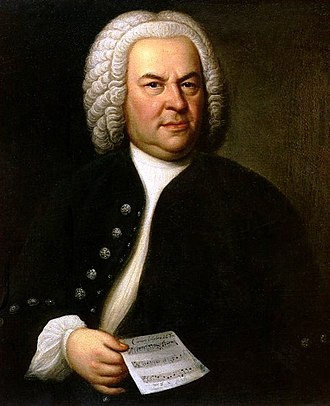
Johann Sebastian Bach (1685-1750) was a German composer of the Baroque period and one of the most influential musicians in Western history. He was also a gifted organist, harpsichordist, violinist, and violist.
We have over 440 different arrangements of Bach’s works on the website. Whether you are looking for Anna Magdalena No. 7 for Clarinet, an abridged first movement of Brandenburg Concerto No.4 for mixed ensemble or bwv 1068 AirBach-BWV-1068-2nd-mvt-Air-on-G-Cello.php on G Cello and Piano you are sure to find something to suit you on music-scores.
Bach came from a family of musicians, teachers, composers, and church organists. The BWV (Bach-Werke-Verzeichnis) catalogues more than 1,100 of his works, and scholars believe many more have been lost.
His best-known works are The Well Tempered Clavier, Toccata and Fugue in D Minor, Air on the G string, Goldberg variations, and Harpsichord concerto in D Minor to name a few. Bach’s Six Suites for Unaccompanied Cello are amongst our favourites. You can find out more about the evolution of the cello on our blog post.
Why not listen to Bach’s ‘The Well Tempered Clavier’ on YouTube..
Family and Early Life
Bach was born in Eisenach in 1685, the son of Johann Ambrosius Bach and Maria Elisabeth Lämmerhirt. His mother died when he was nine, then his father passed away within a year, making him an orphan by the age of 10. He went to live with his older brother Johann Christoph, who had studied with Johann Pachelbel and continued Bach’s musical education.
In 1707 Bach married his second cousin, Maria Barbara Bach. They had seven children, though only four survived to adulthood. In 1720, while Bach was away travelling with his employer, Maria Barbara died suddenly at just thirty-five. By the time he returned, the family had already buried her.
Seventeen months later he married Anna Magdalena Wilcke, a talented singer sixteen years his junior. They had a further thirteen children, six of whom survived to adulthood.
Did You Know?
Bach had twenty children, ten of whom survived. Four became successful composers in their own right: Wilhelm Friedemann, Carl Philipp Emanuel, Johann Christoph Friedrich, and Johann Christian.
Bach is said to have enjoyed hiding the numbers fourteen and forty-one in his music. In the old German system where letters stand for numbers, B-A-C-H adds up to 14, and J.S. Bach adds up to 41.
In 1717 he was imprisoned for almost a month by the Duke of Weimar after pressing to leave his post for a better one. He is thought to have used the time to work on his Orgelbüchlein (Little Organ Book), so perhaps it wasn’t all bad.
Later Years
By the late 1740s Bach’s eyesight was failing badly. In 1750 he underwent eye surgery, but the operations left him completely blind. He died in Leipzig on 28 July 1750, aged sixty-five, after suffering a stroke. Historians still debate how much the surgery contributed to his decline.
Rediscovery and Legacy
Within a generation of his death, audiences considered Bach’s music old-fashioned. It took Felix Mendelssohn’s 1829 revival of the St Matthew Passion to bring him back to wide public attention. Today many regard him as one of the greatest composers of all time, and his music even travels aboard the Voyager Golden Records, which NASA launched into space in 1977.
Bach Sheet Music Downloads & Further Reading
On music-scores.com we have over 440 different arrangements of Johann Sebastian Bach Sheet Music in PDF format for you to download.
For further information take a look at Wikipedia or Britannica.
Pingback: Johann Pachelbel: 1 Sept 1653 - 9 March 1706 (baptised/burial dates) - Music Scores Blog
Pingback: Felix Mendelssohn: 3 Feb 1809 - 4 Nov 1847 - Music Scores Blog
Pingback: Girolamo Frescobaldi: Sept 1583 - 1 March 1643 - Music Scores Blog
Pingback: Leopold Godowsky: 13 Feb 1870 - 21 Nov 1938 - Music Scores Blog
Pingback: Benjamin Godard: 18 Aug 1849 - 10 Jan 1895 - Music Scores Blog
Pingback: Bach CPE: Carl Philipp Emanuel: 8 March 1714 - 14 Dec 1788 - Music Scores Blog
Pingback: Godard: Benjamin: 18 Aug 1849 - 10 Jan 1895 - Music Scores Blog
Pingback: Brahms: Johannes: 7 May 1833 - 3 April 1897 - Music Scores Blog
Pingback: Corelli: Arcangelo: 17 Feb 1653 - 18 Jan 1713 - Music Scores Blog
Pingback: Couperin: Francois: 10 Nov 1668 - 11 Sept 1733 - Music Scores Blog
Pingback: Recently Added Sheet Music: 4 December 2020 - Music Scores Blog
Pingback: Mendelssohn: Felix: 3 Feb 1809 - 4 Nov 1847 - Music Scores Blog
Pingback: Pachelbel: Johann: bapt. 1 Sept 1653 - bur. 9 March 1706 - Music Scores Blog
Pingback: Vivaldi: Antonio: 4 March 1678 - 28 July 1741 - Music Scores Blog
Pingback: Telemann: Georg Philipp. Sheet Music and Biography - Music Scores Blog
Pingback: Frescobaldi: Girolamo. Sheet Music and Biography - Music Scores Blog
Pingback: Reiche: Gottfried. Sheet Music and Biography - Music Scores Blog
Pingback: Godowsky: Leopold. Sheet Music and Biography - Music Scores Blog
Pingback: Scarlatti: Domenico. Sheet Music and Biography - Music Scores Blog
Pingback: Alkan: Charles-Valentin. Sheet Music and Biography - Music Scores Blog
Pingback: Marcello: Alessandro. Sheet Music and Biography - Music Scores Blog
Pingback: Haydn: Franz Josef. Sheet Music and Biography - Music Scores Blog
Pingback: Gounod: Charles-François. Sheet Music and Biography - Music Scores Blog
Pingback: Palestrina: Giovanni Pierluigi da. Sheet Music and Biography - Music Scores Blog
Pingback: Winter Music
Pingback: Baroque Music: a Journey into Ornate Elegance
Pingback: Oboe Sheet Music
Pingback: Halloween Music and Traditions
Pingback: Composers Born in March